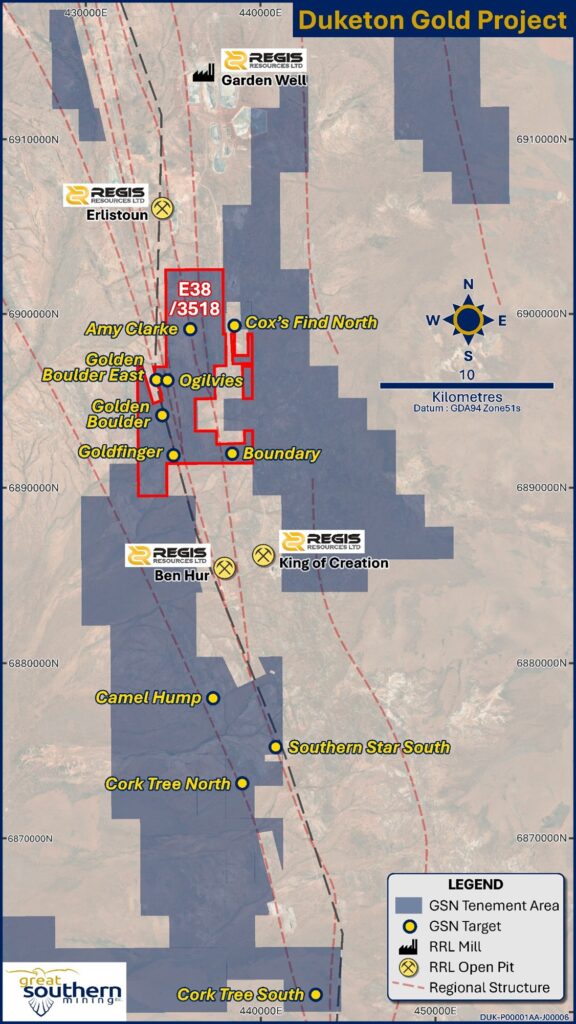
GSN’s shares the Duketon Greenstone Belt with gold producer Regis Resources Limited, which has been successful in the identification of +8Moz of gold resources (refer to RRL’s website). The majority of these deposits reside on major well understood shear zones. GSN’s tenure in the Duketon Greenstone Belt includes significant portions of these shear zones and through the use of magnetic data and geological mapping, GSN immediately identified these shear zones as high priority target corridors, and have aggressively begun to explore these well understood trends. It is interpreted that all three mineralised corridors continue into the company’s tenure with:
- ~8km of the Erlistoun Trend
- ~7km of the Garden Well Trend
- ~11km of the Rosemont-Ben Hur Trend
Golden Boulder
In May 2023 the Company announced the results of a recently completed Air Core (AC) program comprising 3,445m targeting two lines of mineralisation identified as the Golden Boulder Main and the Golden Boulder East trends. Both trends are delineated by historic gold workings which extend for over 3km. Golden Boulder is interpreted to sit along the greater Rosemont trend which hosts Regis Resources’ Rosemont (~1,06Moz Au) and Ben Hur (~390koz Au) deposits and GSN’s Southern Star prospect to the south.
Previous to GSN, drilling in the area was sparse, shallow and untargeted, averaging just 40m below surface.
Results indicate the potential to host economically significant gold mineralisation with both trends intersecting ore grade intercepts and continuous mineralisation over a considerable strike length. All significant intercepts from the recent AC drilling reside within the oxide zone.
Mineralisation has been delineated along three parallel trends, denoted as the Main line, Eastern line and Ogilvies.
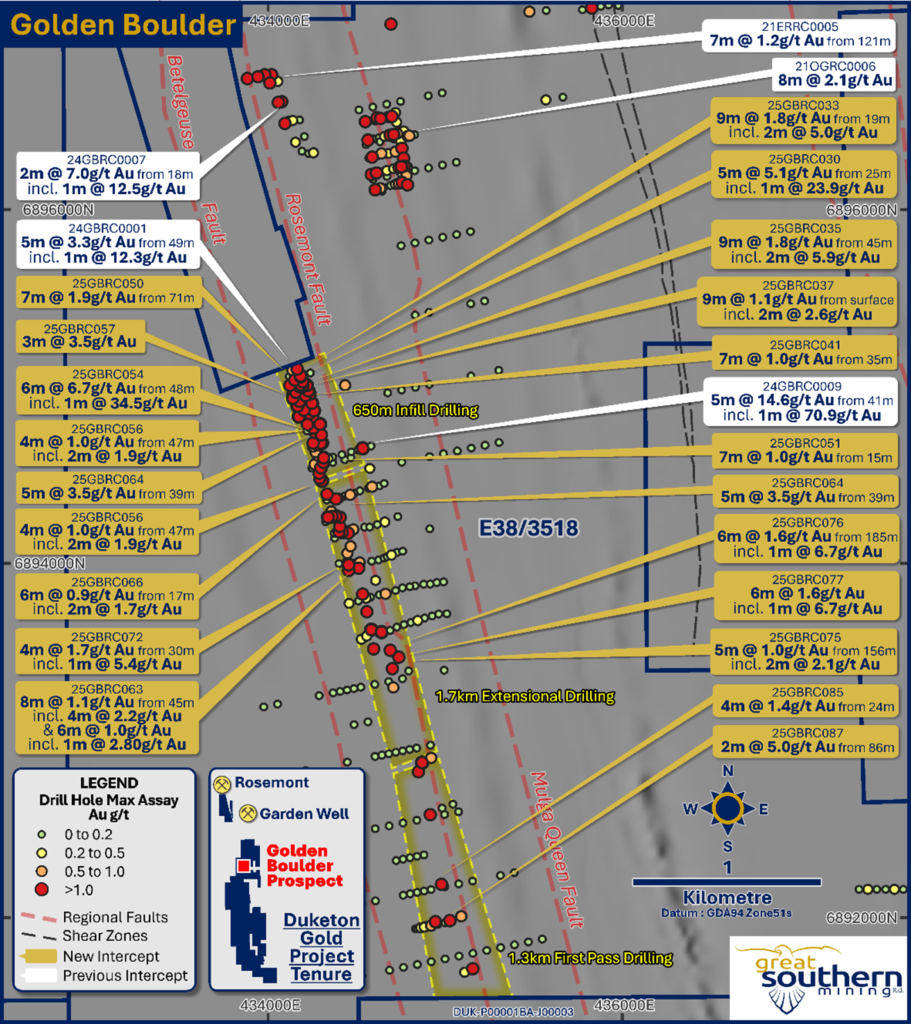
Golden Boulder Main
Golden Boulder Main was identified as a high priority drill target when GSN first acquired the tenement (E38/3518) in 2020. Golden Boulder consists of over 50 shallow shafts with a reported historic production of 1,915 tonnes at 28.6 g/t Au for 1,761 ounces of gold (WAMEX report A85278). Chlorite altered sheared basalt with smokey quartz veins appears to host the highest grade gold.
Standout intersections from GSN’s first pass 16-hole drilling campaign in 2021 (Refer to GSN ASX announcement dated 23 September 2021) returned intercepts including:
- 5m @ 3.3 g/t Au from 49m, including 1m @ 12.3 g/t Au and 1m @ 1.2 g/t Au from 73m in 21GBRC0001, and
- 5m @ 1.2 g/t Au from 103m, including 1m @ 4.1 g/t Au in 21GBRC0007.
The 2023 AC drilling was designed to extend the mineralisation along strike to the south, with ~200m spaced lines perpendicular the interpreted mineralised trend. New intersections along the predicted line of mineralisation have increased the strike of Golden Boulder substantially with a 1.6km anomalous gold trend now defined. Significant intersections include:
- 12m @ 1.3 g/t Au from 44m, including 4m @ 2.4 g/t Au 48m in 23GBAC022,
- 12m @ 0.6 g/t Au from 20m, including 4m @ 1.0 g/t Au 24m in 23GBAC057, and
- 4m @ 2.4 g/t Au 44m in 23GBAC059.
Main line mineralisation from 2024 and early 2025 included intercepts as follows:
- 4 m at 2.03 g/t Au from 24 m, including 2 m at 3.5 g/t Au, 5 m at 14.57 g/t Au from 41 m, including 1 m at 70.94 g/t Au, and 2 m at 2.15 g/t Au from 69 m and 1 m at 1.4 g/t Au from 87 m in hole 25GBRC009
- 2 m at 12.56 g/t Au from 99 m, including 1 m at 18.21 g/t Au in hole 25GBRC007
- 3 m at 4.80 g/t Au from 18 m, including 1 m at 12.45 g/t Au hole 24GBRC0007
- 4 m at 5.64 g/t Au from 63 m, including 2 m at 9.89 g/t Au in hole 24GBRC0005
- 3 m at 2.85 g/t Au from 120 m, including 1 m at 5.56 g/t Au in hole 25GBRC011
- 8 m at 1.77 g/t Au from 27 m, including 3 m 2.36 g/t Au and 1 m at 3.17 g/t Au in hole 25GBRC021
- 5 m at 3.30 g/t Au from 49 m
In October 2025, the Company completed a 90 hole RC program.
The drilling program had three core objectives, all of which have been achieved:
- Infill and extensional drilling, working towards a maiden JORC Mineral Resource in the north of the prospect.
Result: Significantly improved continuity and understanding of the controls on mineralisation with intercepts including (all previously reported1):
- 2m at 2.2 g/t Au from 39m and 6m at 6.7 g/t Au from 48m, including 1m at 34.5 g/t in hole 25GBRC054
- 5m at 5.1 g/t Au from 25m, including 1m at 23.9g/t Au in hole 25GBRC030
- 9m at 1.8 g/t Au from 19m, including 2m at 5.0 g/t Au, and 1m at 1.8g/t Au from 56m in hole 25GBRC033
- 9m at 1.8 g/t Au from 45m, including 2m at 5.9 g/t Au in hole 25GBRC035
- 7m at 1.9 g/t Au from 71m in hole 25GBRC050
- 9m at 1.1 g/t Au from surface, including 2m at 2.6 g/t Au in hole 25GBRC037
- 7m at 1.0 g/t Au from 15m in hole 25GBRC051 (Figure 2)
- Extending known mineralisation to the south along 1.7km of the prospective structural trend where drill spacing is sparce and very few historic holes penetrated beyond 20m depth.
Result: Significant gold intercepts were recorded in every drill line crossing the prospective shear zone. Drilling remains sparce with gaps of up to 450m between drill lines. Better intercepts in this zone include:
- 5m at 3.5 g/t Au from 39m and 2m at 1.1 g/t Au from 74m in hole 25GBRC064
- 8m at 1.1 g/t Au from 45m, including 4m at 2.2 g/t and 6m at 1.0 g/t Au from 64m, including 1m at 2.8g/t Au in hole 25GBRC063
- 3m @ 3.5 g/t from 72m in hole 25GBRC057
- 3m at 1.4 g/t Au from 64m and 5m at 1.0 g/t Au from 156m, including 2m at 2.1 g/t Au in hole 25GBRC075
- 4m at 1.7 g/t Au from 30m, including 1m at 5.4 g/t Au in hole 25GBRC072
- 3m at 1.0 g/t Au from 30m, including 1m @ 2.3 g/t Au from 31m in hole 25GBRC059
- 2m at 1.0 g/t Au from 64m and 2m at 1.2 g/t Au from 160m and 6m at 1.6 g/t Au from 185m, including 1m at 6.7 g/t Au in hole 25GBRC076
- 2m at 1.7 g/t Au from 98m in 25GBRC069
- 6m at 0.9 g/t Au from 17m, including 2m at 1.7 g/t Au in hole 25GBRC066
- 1m at 1.2 g/t Au from 76m in hole 25GBRC060
- 3m at 1.3 g/t Au from 109m, including 1m at 2.5 g/t Au in hole 25GBRC073
- 1m at 1.8 g/t Au from 36m and 1m at 1.1 g/t Au from 92m in hole 25GBRC074
- 10m at 0.6 g/t Au from 39m, including 3m at 1.1 g/t Au in hole 25GBRC077
- Completing first pass drilling along the southernmost 1.3km of the prospective structural trend. This zone incorporates several structural offset targets defined by airborne magnetic geophysics.
Result: Significant gold mineralisation recorded in an area which was historically drilled to an average depth of only 10-20m. Every drill line from the 2025 program which crossed the prospective shear zone recorded significant gold intercepts (~200m line spacing). Better intercepts in this zone include:
- 2m at 5.0 g/t Au from 86m in hole 25GBRC087
- 5m at 0.9 g/t Au from 133m, including 1m at 2.5 g/t Au in hole 25GBRC090
- 2m at 1.0 g/t Au from 60m in hole 25GBRC081
- 2m at 1.2 g/t Au from 78m in hole 25GBRC082
- 4m at 1.4 g/t Au from 24m in hole 25GBRC085
Amy Clarke
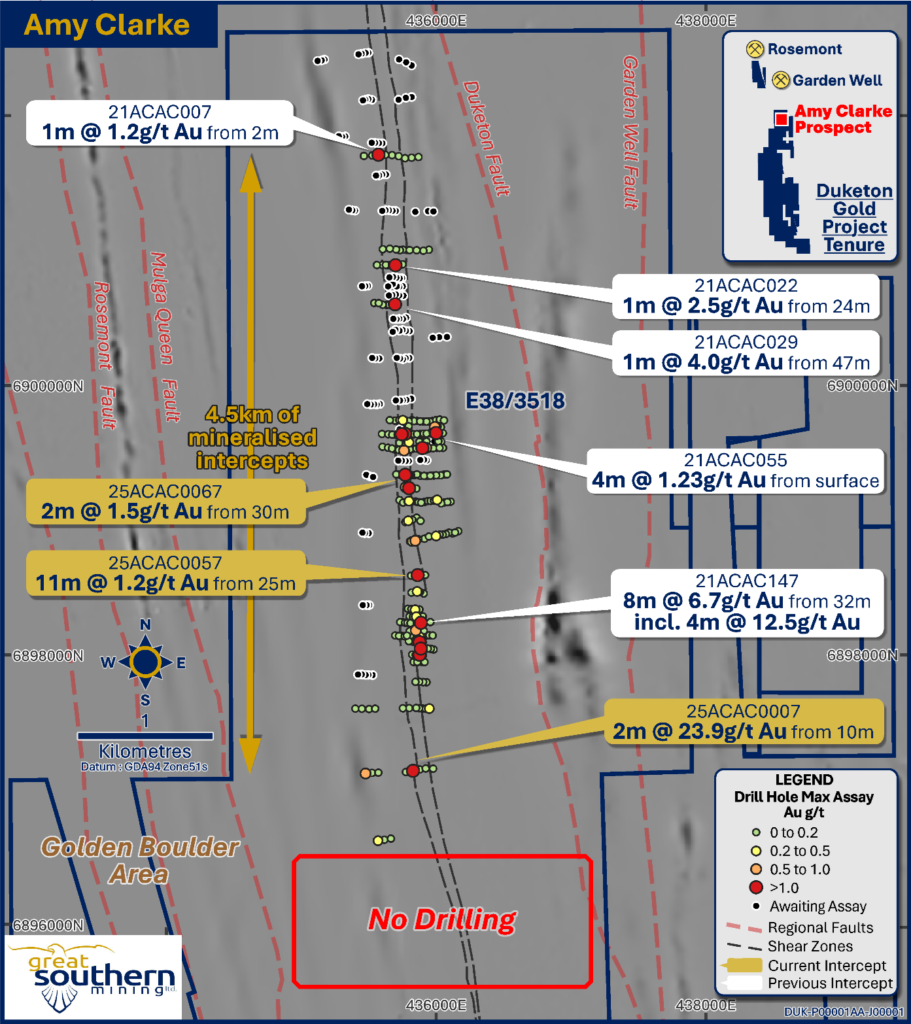
Amy Clarke sits in a high strain structural zone with overprinting sericitic alteration associated with shearing and related folding. An extensive gold-bismuth-lithium-tungsten surface geochemical anomaly extends from the northern tenement boundary for approximately five kilometres south . This anomaly is interpreted to lie on the same structural trend that hosts Regis Resources’ Erlistoun open pit mine (320 koz gold) located approximately 3.5 kilometres to the north.
Broad spaced aircore drilling in 2021 defined two mineralised gold trends with better intercepts including:
- 8m @ 6.73 g/t Au from 32m including 4m @ 12.5 g/t Au in 21ACAC147
- 4m @ 2.13 g/t Au from surface in 21ACAC038
- 4m @ 1.23 g/t Au from surface in 21ACAC055
In October 2025 the Company recently completed an 8,057 metre aircore drilling program over a strike length of ~6 kilometres.
Air-core traverses were spaced at 100 to 400 metre intervals, with holes positioned every ~25 m along each fence. Drilling reached an average downhole depth of ~40 m, providing good coverage across the target corridor. This drilling was designed to follow up on 2021 gold intercepts and to test key structural and geochemical targets. Assay results have been received for 80 holes with better results including:
- 2m at 23.9 g/t Au from 10m in hole 25ACAC0007
- 11m at 1.2 g/t Au from 25m, including 6m at 1.7 g/t Au hole 25ACAC0057
- 2m at 1.5 g/t Au from 30m in hole 25ACAC0067
- 5m at 0.4 g/t Au from 1m in hole 25ACAC0089